 |
Chapter One: On Becoming a Poet Chapter One: On Becoming a Poet features short, original memoirs by outstanding poets from diverse backgrounds who recall the various ways they found their start as writers. While university creative writing programs generally seek to develop the talents of maturing writers, essential information about the development of the craft can be discovered in these early memoirs—the Chapter Ones—answering vital questions such as: How does one become a poet? What is creativity? Where does poetry come from? This anthology collects 25 original memoirs of beginnings, including essays and interviews, all making their first appearance in print. |
|
Creativity: Where Poems Begin by Mary Mackey Creativity: Where Poems Begin is a meditation on how the sources of creativity emerged from a vast, wordless reality and became available to me as a poet. As such, it is not only a memoir; it is an exploration of the power and process of becoming a poet. What is creativity? Where do creative ideas come from? What happens at the exact moment a creative impulse is suddenly transformed into something that can be expressed in words? To describe creativity is extraordinarily difficult because the moment of creation comes from a place where language does not exist and where the categories that determine what we see, hear, taste, and feel are not immediately present. In our daily lives we tend to live on the surface, unaware of the complexity and richness of what lies below. Poetry creates itself, bubbling up from the depths until it reaches that part of our brains that transforms consciousness into words. Poetry chose me. I did not choose it. This book is a journey to that place where all poems begin. |
|
Plan B: A Poet’s Survivors Manual by Sandy McIntosh Teaching positions at universities have often been the preferred destinations of American poets, but with the overwhelming success of MFA programs, tens of thousands of their graduates now must vie for a limited number of part-time and full-time positions. This means many will have to look elsewhere for work. In other words, they will need to devise and follow a Plan B. Award-winning poet, Sandy McIntosh had to come up with his own Plan B when his first part-time teaching position was suddenly eliminated. Far from being an unsurmountable obstacle, this launched him on a life-long career in projects that used his writing abilities. In Plan B: A Poet’s Survivors Manual, he explains how—far from corrupting his poetry— working in different writing genres enhanced his personal creative work while providing a secure financial basis upon which to continue building his craft. |
|
Craft: A Memoir by Tony Trigilio In Craft: A Memoir I explore the writer’s craft through a series of short, linked personal essays. Each chapter features an anecdote from my development as a writer that illustrates craft elements central to my body of work. Craft: A Memoir is an effort to understand craft through discussions of the direct experience of writing itself—through stories of how I became a writer. When we talk about “craft” as writers, we frequently focus on clinical, literary-dictionary terms such as language, narrative, structure, image, tone, and voice, among others. To be sure, this book considers such conventional craft elements—especially questions of language, narrative, and structure—but as a book focused on storytelling and memoir, it also emphasizes craft elements such as: generative strategies and revision; persona and voicing; appropriation and remixing; documentary poetics; traditional and experimental poetic forms (including the role that an expanded conception of “ekphrasis” can play for twenty-first century writers); the relationship between music composition and poetry; the role of narrative in lyric poetry; the importance of the ordinary and the mundane; the importance for poets of reading prose; and the artistic benefit of blurring the boundary between history and craft. |
|
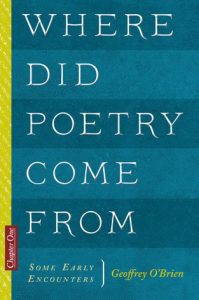
Where Did Poetry Come From: Some Early Encounters by Geoffrey O’Brien Where Did Poetry Come From” Some Early Encounters is a fascinating origin story of a poet’s beginnings. As poet Thomas Devaney noted: “Sensuous, tender, poignant, and a dark delight, Geoffrey O’Brien’s Where Did Poetry Come From is a miraculous source book. This is an origin story of origin stories, a human genome project of the lyric. . . It is a book of first voices and points of contact. ‘To come to know a nonsense word,’ O’Brien tells us, ‘was to know for the first time what a word was.’ The book’s easeful and probing voice maps and identifies the deep byways of memory and song underlying a life: ‘a single random life, a question permanently open like a vowel that finds no consonants to give it form and duration and direction.’”
|
